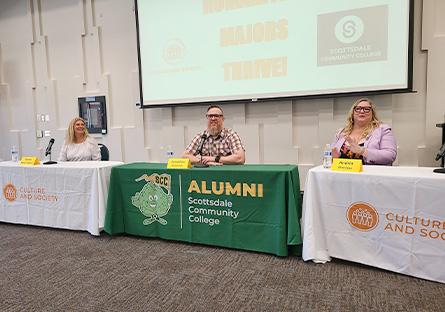
Panelists (Tamra Gagnon, Jonathan Danielson — SCC alum, and Andria Sheridan - SCC alum — left to right) share how their humanities backgrounds have shaped their professional success during the Culture and Society FOI Career Panel.
Students explore the real-world impact of a humanities education through the success stories of SCC alumni.
Inspiring Alumni Share Their Career Journeys
Students in the Culture and Society Field of Interest (FOI) recently discovered how a humanities education can open doors to meaningful and successful careers. The event, “Humanities Majors Thrive: Successful Careers with Real People in a Real World,” brought together local professionals and SCC alumni who shared how their studies shaped their professional paths.
Citing an article from a few years ago in The New Yorker magazine, where the author claimed that enrollment in the humanities is in free fall, Culture and Society FOI leaders at SCC wanted to offer a different picture for students. Advising Lead Dr. John Konicek opened the event with evidence showing the continued need for the humanities in today’s world.
“Culture and Society majors, which turn into Humanities bachelor’s degrees, rank highest nationally for acceptance rates to law school, medical school, and MBA programs,” Konicek reported.
Panelists included Andria Sheridan (Art History, SCC alum), Jonathan Danielson (Creative Writing, SCC alum), and Tamra Gagnon (Mass Communication and Art History). Each panelist reflected on how communication, creativity, and curiosity have guided their success across diverse industries.
“It was a full-circle moment for me to speak about the gift that SCC provided to me as the launch point into my career,” said Sheridan.
Real-World Connections and Career Insights
Programs in the Culture and Society FOI focus on understanding humanity, society, and human expression. These programs foster critical thinking, creativity, and flexibility — skills that help students adapt and thrive in a changing world.
Career panels like this one provide students with valuable insight into different industries, helping them understand job roles, workplace expectations, and the numerous ways humanities studies translate to real-world success.
“I am honored that my remarks resonated with the students and staff,” said Gagnon. “It was a privilege to contribute to the conversation and support students’ growth.”
Words of Wisdom from the Panel
Panelists offered practical advice for students preparing to launch their own careers:
- Tamra Gagnon: “Be open to opportunities that come your way. Walk through the door of opportunity. Learn how to communicate. Have confidence in the skills you’ve learned, such as storytelling. Do what you love.”
- Jonathan Danielson: “Develop humility as part of a good work ethic. You are in an apprentice stage of your life. Creativity is a skill you develop — you’re not going to know everything.”
- Andria Sheridan: “Make connections. Ask for mentorship. Hone your people skills. Remain curious and embrace lifelong learning — the curious people are the ones who get promoted.”
The Humanities in the Age of AI
When asked about the impact of artificial intelligence, both Sheridan and Danielson encouraged students to view it as a tool, not a replacement for human creativity.
“AI can streamline processes, but it can’t replace imagination,” said Danielson.
Sheridan added that art continues to play a vital role in communicating human thoughts, emotions, and ideas — something technology can’t replicate. Danielson concluded by emphasizing that humanities education uniquely teaches metacognition and abstract thinking — critical skills for success in an increasingly AI-driven world.
Top 3 Takeaways from the Panel
- Stay Curious: Lifelong learners are those who continually grow and advance.
- Build Relationships: Mentorship and connection are key to opportunity.
- Use Your Skills with Confidence: Communication, creativity, and storytelling are powerful assets in any career.
Why Study Humanities
A humanities education cultivates the ability to think critically, communicate clearly, and understand diverse perspectives — skills that are in high demand across professions. Graduates from SCC’s Culture and Society Field of Interest go on to careers in communication, education, marketing, design, public service, media, and beyond.
SCC Culture and Society graduate Wendy Richardson, who later completed her Bachelor of Science in Communication at ASU, found the panel discussion particularly meaningful.
“Each of the panelists recalled the impact that their college instructors had on their academic success and later professional careers,” Richardson said. “Our Culture and Society faculty not only taught us well, they really connected with us and showed us the value of what we were pursuing.”
Humanities majors don’t just study people — they learn how to connect, lead, and make an impact in the real world.
View SCC’s extensive degree and certificate programs in Culture and Society.