Immediate and Permanent Access to Knowledge
Open Educational Resources (OER) are learning materials that are free to use, adapt, and share because they are either in the public domain or available under an open content license (such as those developed by Creative Commons). Open educational resources include:
- Full courses, course materials, content modules, learning objects, collections, textbooks, lecture captures and journals.
- Software to support the creation, delivery, use and improvement of open learning content including searching and organization of content, content and learning management systems, content development tools, and on-line learning communities.
The permissions of open licensing allow instructors to customize their materials for the specific needs of their students and for students to share their learning resources with the world.

OER@SCC
Scottsdale Community College cares about student textbook costs and equitable access to information. Many of SCC's faculty members have chosen to use openly licensed materials in their courses instead of expensive publisher textbooks. These materials maintain quality while radically decreasing student costs. View a sample of OER materials created and remixed by SCC faculty.
SCC’s OER Committee is committed to educating stakeholders on the benefits of OER, facilitating the discovery and creation of OER curriculum, and developing innovative strategies for sustainability.
To support faculty adoption and adaptation of open materials, SCC provides professional development opportunities and funding to compensate faculty for authoring new materials, remixing existing materials, or managing master courses.
Additional information is available on our faculty resources page.

Open Maricopa
Access, Equity, and Quality through Open Educational Resources
Scottsdale Community College works in close coordination with Open Maricopa, a district-wide initiative to support faculty working with open educational resources and pedagogies.
Maricopa Community Colleges’ history of embracing affordable textbooks and OER began in Spring 2013 with the launch of the “Maricopa Millions” initiative. This ambitious effort aimed to save students $5 million through low-cost and no-cost materials across the district’s 10 colleges. The program exceeded expectations by meeting its original goal in just two and a half years, and ultimately generating over $270 million in cumulative textbook savings to date.
Maricopa also became the first institution in the nation to designate course filters to search for courses that utilize LTC and ZTC materials. These clear markers make it easy to identify affordable options in the class schedule, and underscore the district’s commitment to textbook affordability.
By Fall 2021, “Maricopa Millions” evolved into “Open Maricopa,” reflecting an expanded commitment to affordability, innovation, and accessible learning. Today, Open Maricopa continues our decade-long dedication to providing high-quality, cost-effective educational resources.
With the money I spent on textbooks, I could have…
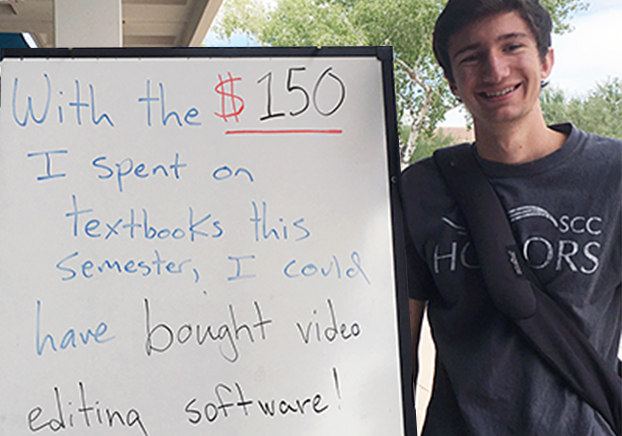
Bought software
With the $150 I spent on textbooks this semester, I could have bought video editing software!
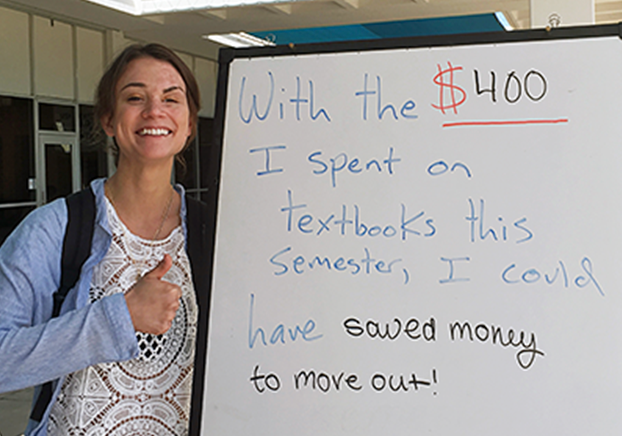
Moved out
With the $400 I spent on textbooks this semester, I could have saved money to move out!
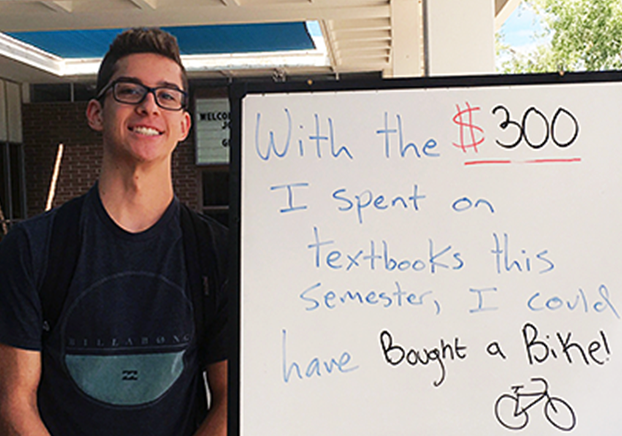
Bought a bike
With the $300 I spent on textbooks I could have bought a bike!
Paragraph Video and Text Block: 511
See what students in Maricopa have to say about how OER has impacted their college success and access to knowledge.
For more information, contact:
- Center for Teaching and Learning
- Phone: (480) 425-6952
- [email protected]
OERizona
 Scottsdale Community College is a member of the OERizona Network, a grassroots initiative connecting all of the institutions of higher learning statewide. Founded in 2019 at the Arizona Regional OER Conference hosted by Open Maricopa, the network merged with the Open Textbooks for Rural Arizona project in 2024 and supports member institutions by offering professional development, a learning materials repository, and the annual OERizona Conference. For more information, see the Faculty Resources page.